Holy Trinity Orthodox Church

What Is Sin?

"One position, following the Wesleyan tradition, says that sin is a 'willful transgression of the known will of God', while another is more Calvinistic position is a 'deviation from a standard of perfection.' What is the Orthodox definition of sin?" Answer
You are here:Home arrow About arrow Liturgical Guide for Our Visitors
  • Decrease font size
  • Default font size
  • Increase font size
A Visitor's Guide to the Divine Liturgy
Article Index
A Visitor's Guide to the Divine Liturgy
Page 2
Page 3

The Orthodox Church has been called "the best kept secret in America." Even for Christians familiar with one of the Western liturgical traditions, some of our practices may seem foreign. And for Christians and others who are utterly unfamiliar with liturgies, some of our practices may seem unnecessary. We have anticipated some of your likely questions below. With the answers provided, you will discover that the Orthodox Liturgy engages all the senses and addresses the spiritual needs of the whole person: "O taste and see that the Lord is good" ( Psalm 34:8).

Visitor's Guide to the Divine LiturgyWhy is the service called "The Divine Liturgy?" Who is St. John Chrysostom? "Liturgy" comes from a Greek word that means "a common effort" and "divine" relates to the worship of God. So the Divine Liturgy is the common effort of Orthodox Christians to worship God. It is the primary public form of Orthodox Christian worship, wherein we celebrate the Eucharist -- Holy Communion with God in Christ. The version of the Divine Liturgy celebrated on most Sundays is that of St. John Chrysostom, the 5th century Archbishop of Constantinople, capital of the Eastern Roman Empire. We also use the slightly longer Liturgy of St. Basil the Great, the 4th century Archbishop of Caesarea, on 10 occasions each year.

Is childcare available during the service? Is there a children's church service? Children's church school is held at the conclusion of Liturgy. We do not offer childcare or hold a separate children's service because children benefit no less than adults from participating in worship and by receiving Communion (see Matthew 19:14, Mark 10:14, and Luke 18:16). Infants baptized in the Orthodox Church are considered fully part of the Church. Moreover, we encourage families to worship the Lord together. We anticipate a certain level of distraction and noise from very young children, the sound of a healthy and growing community. In fact, one American Orthodox theologian, Fr. Alexander Schmemann, referred to the activity of children during Liturgy as "holy noise." Of course, very disruptive children should be taken outside until they become cooperative again. Nevertheless, Orthodox practice is for the whole community to worship together.

Why are bells rung during the service? The ringing of bells serves as a call to worship and an announcement of certain parts of the Liturgy. Bells are run at the beginning of Liturgy, during the recitation of the Nicene Creed, during the Lord's Prayer, and at the end of Liturgy.

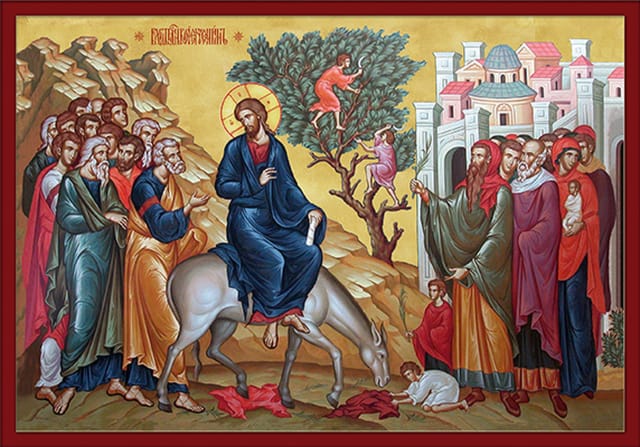
Why is the building decorated with so many portraits and other paintings? Are they idols? Why do you kiss them? Those paintings are "icons", a Greek word for "images." Icons are stylized representations of Christ, the Virgin Mary, other Saints, and scenes from the Bible and Church history. Ages ago, when few people were literate, icons were non-verbal teaching tools. Icons use very specific language that can be read. We even say that icons are written rather than painted.

Icons are not idols. Even in the Old Testament, in which God condemned idolatry of images ( Exodus 20:4-5), God ordered angelic images to decorate the Tabernacle and Temple (see Exodus 25-26 and 1 Kings 6). Icons convey deep spiritual truths rather than realisic objects of worship. Orthodox Christians use icons -- sometimes called "windows to heaven" -- as aids to prayer. We kiss icons to show respect to the person or people represented "in spirit and truth" ( John 4:24). For further reading, see here.

Visitor's Guide to the Divine LiturgyWhy are Orthodox Christians continually touching their heads, chests, and shoulders? This is the Sign of the Cross that we make to show our belief in Christ's sacrifice on the cross as well as our commitment to "love God with all your heart, soul, mind, and strength" ( Deuteronomy 6:5, Matthew 22:37, Mark 12:30, and Luke 10:27). The Sign of the Cross is made with the right hand -- the thumb and first two fingers joined to symbolize the divine and human natures of Christ -- touched to the head, chest, right and then left shoulders. Most often we make the Sign of the Cross when we prayerfully mention the name of Lord -- Father, Son, and Holy Spirit -- or when the priest turns to bless the people.

Sometimes we add to the Sign of the Cross a deep bow from the waist, touching our hand to the floor. This is called a "reverence." On certain occasions during the Church calendar, we add to the Sign of the Cross a "prostration," in which we kneel and touch our foreheads to the floor. All of these gestures -- the Sign of the Cross, the reverence, the prostration, and the kissing of icons and other sacred objects -- should be understood in light of James 2: faith and actions working together. These are not superstitious gestures, but prayer from the whole person -- mind, soul, and body.

Why is there a wall at the front of the church? This wall, the "iconostasis", a Greek word that means "icon stand," is an important feature of Orthodox Church architecture. It separates the sanctuary (where the clergy lead prayer before the altar) from the nave (where the people stand and respond in prayer)*. In any Orthodox church, the iconostasis may have two or three tiers of icons, but the main tier of icons follows a customary pattern from left to right. At our church you will see the icon depicting the Old Testament manifestation of the Most Holy Trinity, to whom our church is dedicated, the north door with the icon of St. Michael the Archangel, the icon of the Virgin Mary, the Great Doors with icons of the Annunciation and the Four Evangelists (Ss. Matthew, Mark, Luke, and John), the icon of Christ, the south door with the icon of St. Gabriel the Archangel, and, finally, the icon of the Theophany of Our Lord, depicting Christ's baptism by John the Baptist.

*From Fr. Schmemann’s The Eucharist:
“Altar and nave (ark) are dialogically connected ark points toward altar but altar exists only in relation to the nave.”
“Iconostasis’ (original) purpose was (is) not to separate but to unite. The icon is a witness or rather a consequence of the unification of heaven and earth.”
“An incarnation of the vision of the church … kingdom of heaven has drawn near.”
“At first the icons demanded a wall for support… now it seems the wall demands icons for adornment”